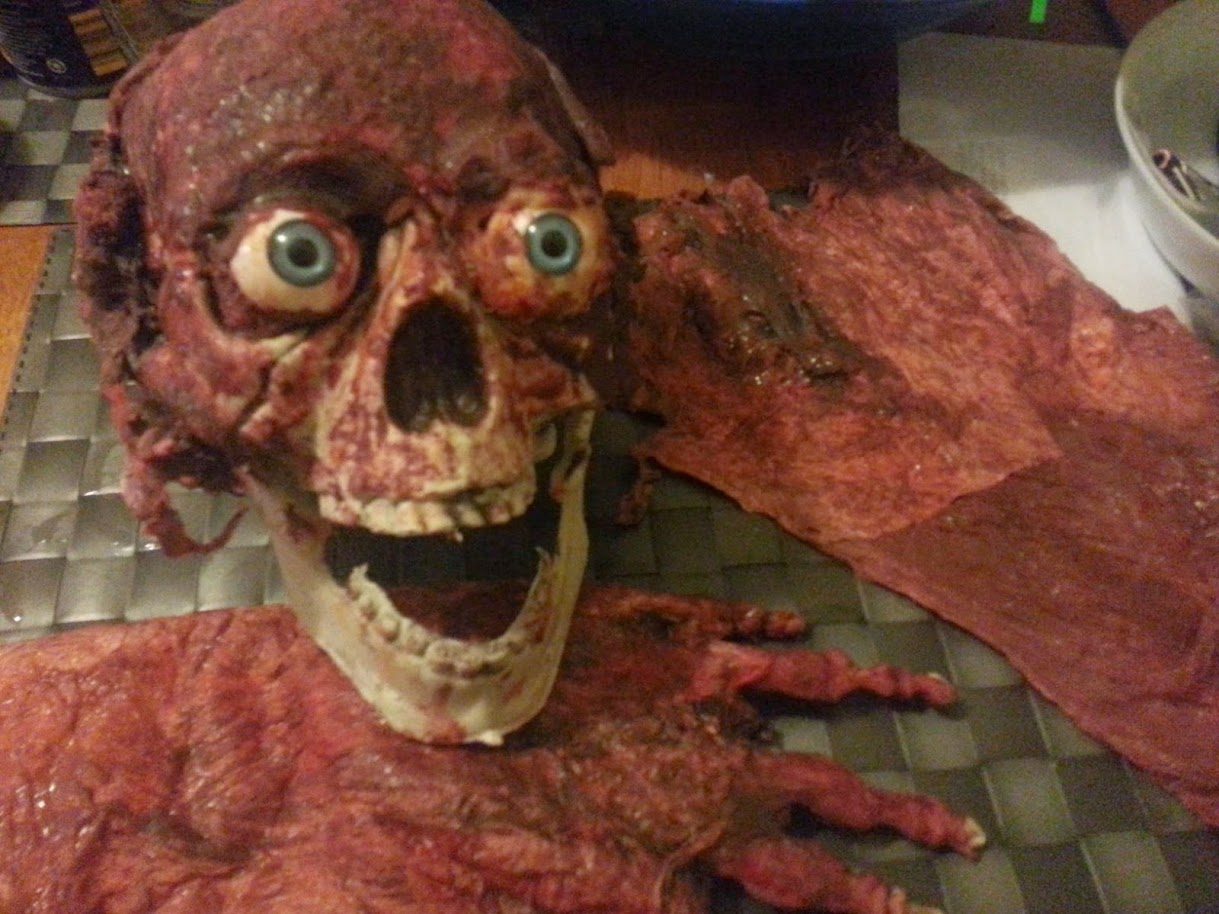
Make a chunky grey matter prop by softening quick oats, mashing in banana and gently folding fake blood through the mixture. Keep some pale lumps visible so the result has contrasting colour and texture. This is a stylised gore effect for a tabletop shot, not an anatomical model.
Watch the original demonstration
Watch the original episode, then use the written guide to plan your own version. Older episodes may include extra demonstrations or reviews.
Make Fake Edible Brains to Splatter for your horror film.
Build chunky grey matter from oats and banana, then gently fold in a suitable fake blood.
Darker • simulated gore. The method comes from the Outback Gorehouse video Make Fake Edible Brains to Splatter for your horror film. Whether your own version is edible depends on every ingredient and how you prepare it.
Set up a small tabletop batch
Gather quick oats, a banana, your chosen fake blood, a heat-safe mixing bowl, a wooden spoon, a fork and a potato masher. Protect the tabletop and choose a washable or disposable surface for the finished prop. Keep the effect contained.
The demonstration uses boiling water. An adult should handle hot water and the hot bowl on a stable surface, with younger helpers supervised. Let the softened mixture cool before handling it or bringing people close for the shot.
Decide at the start whether this is a food preparation or a non-edible prop batch. Keep the ingredients and equipment for those uses separate.
Soften the oats and watch the texture
The video adds approximately half a cup of boiling water to the oats, then shows a porridge-like result after roughly five minutes. The oat quantity is not specified, so those details are a record of the demonstration rather than a reliable ratio for every batch.
Start small. Observe how much water your oats absorb and whether distinct pieces remain visible. The useful target is a soft, lumpy mixture that holds enough texture for the camera. Record what you actually use so a successful test can be repeated.
Mash in the banana without losing every chunk
Add banana once the mixture is cool enough to work with. The demonstration uses a ripe banana. If yours resists mashing, break it into smaller pieces with the fork before combining it with the oats.
Use the potato masher to work the banana through. Pause to inspect the result rather than automatically mashing until smooth. Uneven pieces give the later colour something to sit around and between.
A close-up may need smaller lumps than a wider tabletop view. Judge their size through your planned frame.
Fold in blood instead of stirring everything red
Add a little fake blood and fold it through gently with the spoon. Turn part of the mixture over, check the colour distribution, then decide whether to add more.
The demonstration preserves pale material between the coloured areas. Stirring continuously can remove that contrast and leave a uniformly coloured paste. Stop when you have an arrangement that reads clearly in the shot.
The chocolate-syrup fake blood guide describes another small-batch colour test. Follow its ingredient checks before using that mixture in a food preparation.
Test the result on the table
Place a small portion on the protected surface and photograph it under the intended lighting. Keep the camera at the distance planned for the scene. Check whether the pale chunks remain visible and whether the coloured liquid overwhelms them.
Make three samples from the same base: lightly folded, more coloured and more thoroughly mixed. Compare them using the camera-test method. Choose the version that communicates your intended image rather than the version that looks most extreme in the bowl.
Keep the effect on the tabletop. This exercise does not require throwing, spraying or placing material on a performer.
Make the edible decision before serving anything
An edible version requires every ingredient, including the fake blood, to be food-safe and prepared with clean food utensils. Makeup, liquid latex and other effects supplies have no place in that version. A pantry ingredient mixed with a non-food product is not an edible recipe.
Keep any food portion separate from material handled as a prop. For the shoot, record the mixture and photograph its arrangement before each take. The practical FX continuity guide helps you reproduce the useful result without starting from guesswork.